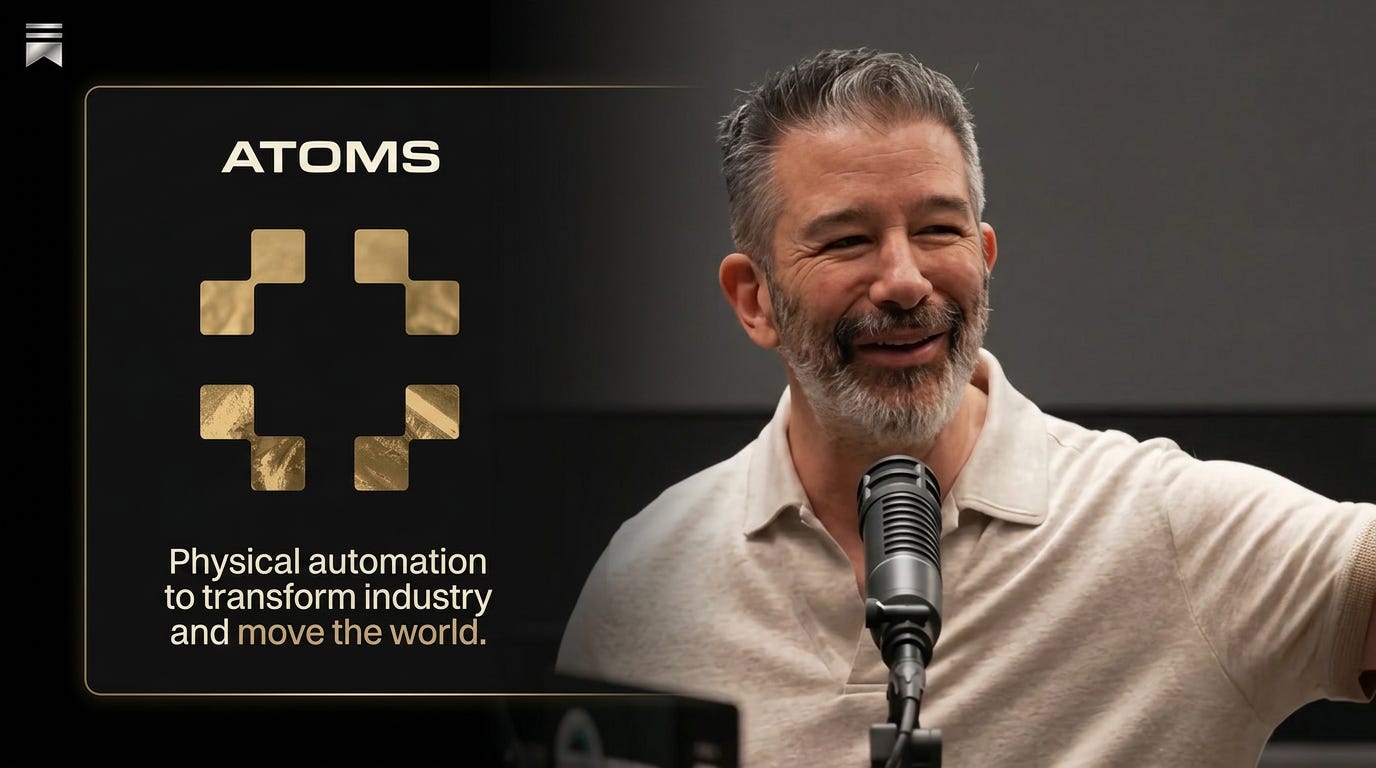
On March 13, 2026, Travis Kalanick walked into a TBPN set and sat down across from podcast hosts John Coogan and Jordi Hays, and did something he hadn’t done in nearly a decade.
He talked.
The TBPN interview ran about an hour. Travis looked different from the guy who’d been photographed screaming at an Uber driver in 2017, or the one in the grey hoodie doing damage control on cable news.
Sulat is a reader-supported publication. To receive new posts and support my work, consider becoming a free or paid subscriber.
He was relaxed. Tan.
He’d moved to Texas the previous December, owns a lakehouse he’s had for five years, and seemed like a man who’d been sleeping well.
The first thing he said that mattered was also the most obvious: “I’ve been in hiding.”
Eight years. His company, originally called City Storage Systems, had operated so deep in stealth that employees couldn’t list the company’s name on their LinkedIn profiles. Thousands of employees, working in more than 110 cities across 30 countries, and the outside world mostly knew them as “that ghost kitchen thing Travis is doing.”
But the interview was less retrospective than launch event.
“We’ve been in stealth mode for eight years. Employees were not allowed to put the name of the company on their LinkedIn.”
Travis revealed the rebrand live on air. City Storage Systems was now Atoms. Three divisions: Atoms Food, Atoms Mining, Atoms Transport. A manifesto had gone up on atoms.co/vision. The thesis was physical AI and robotics. Not the humanoid kind, but specialised machines that could do productive work. He called them “gainfully employed robots.”
He was funny about it, too. He’d originally wanted to call the company Super. “I’m like, you go from Uber to Super. That cannot be a thing. So I did the opposite.” CSS. The most boring name imaginable. And now Atoms, which at least sounded like it meant something.
The interview had a confessional quality. Travis talked about his mother’s death. About being forced out of Uber. About selling his entire stake and walking away from the board. About the years of building in silence. And then, with the casual timing of someone who’d rehearsed it but wanted it to land as spontaneous, he laid out what he’d actually been doing.
“I was the GOAT for a period of time and now I’m a baby goat. And that’s okay.”
He grinned when he said it. The hosts laughed. But the line was doing real work. Travis Kalanick, the most famous founder-exile in Silicon Valley history, was telling the world he was back, and that he’d spent the exile building something bigger than anyone had guessed. Whether you believe him depends on how much credit you give the last eight years. And to understand those years, you have to go back to the beginning.
Act I: The making of a fighter
Travis Kalanick’s origin story is a series of near-death experiences, financial and otherwise. Before Uber made him a billionaire, he spent a decade getting punched in the mouth by the startup world and refusing to stay down. The pattern matters because it explains everything that came after.
Scour: a quarter-trillion-dollar lawsuit at 24
In 1998, Travis co-founded Scour at UCLA. It was a peer-to-peer file-sharing service, essentially Napster’s slightly less famous cousin. The board included Michael Ovitz (the most powerful agent in Hollywood history) and Ron Burkle (the billionaire supermarket magnate). For a college project, it had serious backers.
It also had serious enemies. The RIAA and MPAA sued Scour for $250 billion. Yes, billion. That number is absurd on its face. The entire GDP of Ireland was roughly $100 billion at the time. But the entertainment industry wasn’t interested in proportionality; they wanted to make an example. Scour filed Chapter 11 in September 2000.
Travis was 24 years old. He’d built something that attracted world-class investors and world-class lawsuits in equal measure. The company died. He didn’t.
Red Swoosh: four years without a salary
What Travis did next is the part of his biography that tells you the most about him. He founded Red Swoosh in 2001, a peer-to-peer content delivery network. Same underlying technology as Scour, stripped of the copyright liability. Legal P2P.
The company nearly killed him. He went four years without a salary. Mark Cuban joined the board, which gave it credibility but not necessarily cash flow. Travis has described this period with the kind of reverence that founders reserve for their worst years.
“That company wasn’t meant to be and I willed it into being.”
In 2007, Akamai acquired Red Swoosh for approximately $19 million. Travis walked away with about $2-3 million after taxes. By Silicon Valley standards, this is a rounding error. By the standards of a guy who hadn’t drawn a salary in four years, it was everything.
“[Sold Red Swoosh for] 19 million bucks and probably to this day still the happiest day of my life.”
He elaborated on the TBPN podcast: “I cleared 3 million and I was like praise the Lord.”3 Nine years of work. Two companies. A quarter-trillion-dollar lawsuit. And the payday was three million dollars. Most people would take that as a sign to get a job at Google. Travis took it as proof that he could survive anything.
The fighter’s DNA
The Scour-to-Red Swoosh arc established a template that would repeat twice more. Build something audacious. Get hit with consequences that would destroy most people. Refuse to quit. Grind through years of pain. Come out the other side with a modest win and an appetite for something bigger.
It’s a template that makes Travis simultaneously inspiring and exhausting to deal with. The same stubbornness that kept Red Swoosh alive through four years of zero salary is the same stubbornness that made him impossible to manage at Uber.
The same willingness to fight a $250 billion lawsuit at 24 is the same willingness to fight his own board at 40.
Right, I’m editorialising. But the pattern is worth naming because it’s the key to understanding what happened at Uber and why he didn’t just retire to a beach after selling his stake.
He told the TBPN hosts something that explains the whole trajectory: “If you’re getting money easy, I’m like, why didn’t you go harder? You could have been way better and gone way further.”
That line is both his greatest strength and the thing that nearly destroyed him.
Act II: The Uber machine
Travis Kalanick and Garrett Camp co-founded Uber in 2009. Within eight years it would reach a private valuation of roughly $68 billion, reshape urban transportation worldwide, and become the defining startup of the 2010s. The speed at which it grew was matched only by the speed at which its culture went from asset to liability.
The idea and the co-founder
Garrett Camp, who’d sold StumbleUpon (feel old yet?) to eBay, had the original idea: a black car service you could summon from your phone. Travis brought the operational intensity. The division was clean in the early days. Camp was the product thinker. Travis was the wartime CEO.
The company grew with the kind of velocity that makes investors lose their composure. And Travis knew exactly how to exploit that.
The city-by-city playbook
What made Uber different from other startups wasn’t just the product. It was the expansion model. Travis treated each new city as a standalone campaign. He’d send a small team (sometimes just two or three people) into a market with a simple mandate: get drivers on the platform, get riders using the app, and deal with whatever regulatory backlash follows.
Each city launch was, in effect, a startup within a startup. The local team had to recruit drivers, often by standing outside taxi ranks and offering signing bonuses. They had to generate rider demand, usually through promotional credits and word of mouth. And they had to manage the inevitable fight with local taxi commissions, city councils, and entrenched transport operators who saw Uber as an existential threat.
The playbook was aggressive by design. In many cities, Uber launched before it had regulatory approval, betting that consumer demand would make it politically impossible for regulators to shut the service down. It worked more often than it didn’t. By the time a city council got around to drafting ride-sharing regulations, Uber already had tens of thousands of riders who would scream if the service disappeared.
Travis called this approach “principled confrontation.” Critics called it law-breaking with a PR strategy. Both descriptions were accurate.
The model scaled because Travis had systematised confrontation itself. There was a playbook for the launch, a playbook for the regulatory fight, and a playbook for the press cycle that followed. Each city team ran the same plays, adapted for local conditions.
Fundraising as performance art
The way Uber raised money tells you as much about Travis’s psychology as any profile ever written. At the company’s New York office, he set up four parallel rooms for investor meetings. Each room held a different tier of potential investors. The $250 million-plus club got a room with Travis himself.
Rounds were routinely oversubscribed. Travis ran what amounted to an auction-style book-building process, more typical of an IPO than a private round. Investors competed against each other for allocation. The power dynamic was inverted: founders selecting investors, not the other way around.
The results were obscene. Jason Calacanis’s $10,000 angel cheque grew to roughly $100 million. Early employees became millionaires on paper. The valuation climbed from nothing to $68 billion in under a decade.
But Travis had a philosophy about capital that went beyond fundraising tactics. He saw raising money as a competitive weapon. Every dollar Uber raised was a dollar its competitors couldn’t use. Every oversubscribed round was a signal to the market that resistance was futile.
This philosophy worked brilliantly until the money stopped being the problem.
The culture problem
Uber’s culture was an extension of Travis’s personality: aggressive, competitive, boundary-pushing, and allergic to the word “no.” In the growth phase, this produced a company that expanded into new cities faster than regulators could respond. It also produced a company where a certain type of behaviour was tolerated, then normalised, then baked into the operating system.
The warning signs were there for years before anyone outside the company bothered to notice. Or more accurately, people noticed but the growth numbers made it easy to look away. A company doubling revenue every few months buys a lot of patience from investors and press.
The thing about building a “culture of builders,” as Travis would later describe it, is that the word “culture” can justify almost anything. Move fast and break things. Win at all costs. The competitor is the enemy. These phrases sound exhilarating in a pitch deck and look terrible in a courtroom deposition.
Travis acknowledged this, obliquely, in the TBPN interview. He talked about CSS/Atoms differently: “You then build a culture of builders. You build a culture of people that want to build and do not need to be famous when they do it.” The emphasis on not needing fame felt like a deliberate contrast with the old Uber, where fame and infamy were two sides of the same coin.
Act III: The fall
The destruction of Travis Kalanick’s career at Uber took exactly four months. From Susan Fowler’s blog post in February 2017 to his forced resignation in June, the sequence of events moved with the mechanical precision of a controlled demolition.
Except nobody was in control.
Susan Fowler lights the fuse
On February 19, 2017, Susan Fowler, a site reliability engineer at Uber, published a blog post titled “Reflecting on one very, very strange year at Uber.”
The post went viral. Not in the usual sense of getting a lot of retweets and then being forgotten. It went viral in the sense that it made every subsequent allegation about Uber’s culture land with the force of confirmation rather than accusation.
Uber hired Eric Holder, the former U.S. Attorney General, to investigate. The Holder investigation produced 47 recommendations. On June 6, more than 20 employees were fired. The investigation validated Fowler’s account and revealed that the problems were deeper than anyone outside the company had acknowledged.
The worst week imaginable
And then, in the middle of all of this, the worst possible thing happened.
On May 26, 2017, Travis’s mother Bonnie Kalanick, 71 years old, died in a boating accident at Pine Flat Lake in Fresno County. His father Donald, 78, was seriously injured in the same accident.
Travis was grieving. He was also, simultaneously, the CEO of a $68 billion company under investigation for systemic cultural failures, facing calls for his resignation from investors, board members, and the press.
There is no playbook for surviving both at once.
What happened next is the part of this story where reasonable people can disagree about who was right and who was wrong, but nobody can disagree about the cruelty of the timing.
The letter
On June 20, 2017, less than a month after his mother’s death, five major investors delivered a letter to Travis titled “Moving Uber Forward.” The signatories were Benchmark, First Round Capital, Lowercase Capital, Menlo Ventures, and Fidelity. The letter demanded his resignation.
Travis was in Chicago when he received it. Bill Gurley of Benchmark led the push. Gurley resigned from the Uber board one day after Travis stepped down.
Travis addressed this directly in his Atoms manifesto:
“I left Uber in 2017 heartbroken. I had been torn away from an idea and a movement that I had poured my life into.”
And then, more pointedly:
“It was only days after the death of my mother and the near death of my father in a boating accident when an investor decided to come out from the shadows and exploit this vulnerable moment.”
You can read that as self-serving revisionism. You can also read it as a man describing what it felt like to be pushed out of his own company while burying his mother.
Both readings can be true simultaneously.
The legal aftermath
Benchmark sued Travis for fraud in August 2017. The suit was dismissed in January 2018. In the interval, it served its purpose: keeping Travis away from any attempt to reclaim control.
Travis sold his entire Uber stake between November and December 2019, reportedly realising $2.5-3 billion. He resigned from the Uber board on December 24, 2019.
Christmas Eve.
(The symbolism, intentional or not, was hard to miss.)
Making sense of the exit
Look, there’s a version of this story where Travis is the villain, and parts of that version are supported by evidence. The culture problems at Uber were real. The Holder investigation confirmed them. More than 20 people lost their jobs. Susan Fowler’s experience was not an isolated incident.
There’s also a version where a group of investors used a genuine crisis as cover to execute a long-planned power grab, timing their move to coincide with the most vulnerable moment of their target’s life. Benchmark’s behaviour, in particular, has aged poorly. You don’t lead a campaign to oust a CEO and then resign from the board the next day unless you were more interested in the ouster than in the company.
The truth is probably messier than either version. Uber needed to change. Travis was likely incapable of leading that change, or at least unwilling to. The investors who forced him out were probably right about the diagnosis and wrong about the treatment, and ugly in their execution.
“I bled, but I did not perish. I got back up and fought my way back into the arena, back to my calling. Back to building.”
That’s from the manifesto. It’s dramatic. It’s also, as the next eight years would demonstrate, accurate.
The Levandowski file
Anthony Levandowski is the engineer whose talent for autonomous driving was matched only by his talent for creating legal catastrophes. His saga intersected with Travis’s at the worst possible time, and now, improbably, they’re working together again.
The engineer who started it all
Anthony Levandowski co-founded Google’s self-driving car programme in 2009. He’d previously created 510 Systems, which Google acquired. By most accounts, he was one of the top autonomous vehicle engineers in the world. He was also, by most accounts, not someone who spent a lot of time worrying about employment agreements.
The Otto acquisition
In 2016, Travis hired Levandowski by acquiring his startup Otto, a self-driving truck company. This was part of Uber’s broader push into autonomous vehicles, which Travis had kicked off by establishing a self-driving unit in Pittsburgh in 2015. The strategic logic was sound: if ride-sharing was the business, then removing the driver was the obvious long-term play.
The execution, however, created one of the most expensive legal disasters in Silicon Valley history.
14,000 files
In February 2017, the same month Susan Fowler published her blog post, Waymo (Google’s self-driving car subsidiary) sued Uber. The allegation: Levandowski had downloaded 14,000 confidential files from Google before leaving to start Otto, and those files had made their way to Uber.
The lawsuit settled in February 2018, with Uber paying 0.34% of its equity to Waymo, worth approximately $245 million. That’s a lot of money, but given the potential damages, it was widely viewed as Uber getting off relatively lightly.
Levandowski did not get off lightly.
Criminal prosecution
He was criminally charged in August 2019. In August 2020, a federal judge sentenced him to 18 months in prison. The judge called it “the biggest trade secret crime I have ever seen.”
The judge called the Levandowski case “the biggest trade secret crime I have ever seen.”
Federal judges in Northern California see a lot of intellectual property cases. For a judge to use superlatives on the record means the conduct was extraordinary.
The pardon and the pivot
On January 20, 2021, Donald Trump’s last day in office, Levandowski received a presidential pardon. Peter Thiel reportedly supported the pardon effort. The pardon erased the criminal conviction but couldn’t erase the public record.
Levandowski had founded Pronto in 2018, while still facing criminal charges. Pronto completed the first fully autonomous coast-to-coast drive. In 2024, Pronto pivoted to mining and industrial autonomy.
And Travis Kalanick is Pronto’s largest investor. During the TBPN interview, Travis confirmed that an acquisition of Pronto was closing imminently. The man who was forced out of Uber partly because of the Levandowski scandal is now bringing Levandowski back into the fold.
The reunion nobody expected
This is one of those facts that’s hard to know what to do with. Levandowski committed what a federal judge called the biggest trade secret crime in history. He was pardoned, but the conduct remains a matter of public record. And Travis is not only working with him again but acquiring his company.
There are two ways to read this. The generous reading: Levandowski paid his price, received a pardon, and has spent the years since building a legitimate business in industrial autonomy. People deserve second chances, and Pronto’s technology in mining automation is apparently real. Travis, who knows Levandowski’s capabilities better than almost anyone, is making a rational bet on the engineer’s talent.
The less generous reading: Travis Kalanick, who has described himself as someone who “never left” the arena, is also someone who has never been willing to let a moral complication get in the way of a strategic advantage. The Levandowski hire at Uber was a disaster. Doing it again suggests either extraordinary confidence in Levandowski’s reformation or a familiar pattern of valuing talent over everything else.
Both readings, again, can be true.
Act IV: The ghost kitchen years
City Storage Systems was supposed to be Travis Kalanick’s quiet second act. Instead, it became a $15 billion bet on an industry that largely collapsed, a sandbox for building something nobody expected, and the answer to the question nobody was asking: what does a disgraced tech founder do with $3 billion and a grudge?
The acquisition
In March 2018, three months after Benchmark’s lawsuit was dismissed, Travis bought a controlling interest in CloudKitchens (originally founded in 2016 by Diego Berdakin, Sky Dayton, and Barak Diskin in Los Angeles) for $150 million. He became CEO.
The business model was straightforward. Buy cheap commercial real estate. Convert it into shared kitchen spaces for delivery-only restaurants. Rent those spaces to operators who wanted to reach the delivery market without the overhead of a storefront.
Saudi money
In January 2019, Saudi Arabia’s Public Investment Fund invested $400 million in CSS. The Saudi PIF’s involvement raised immediate ethical questions, coming just months after the murder of journalist Jamal Khashoggi. Travis didn’t address the Saudi investment directly in any public forum. The money spoke for itself: Four hundred million dollars buys a lot of kitchen equipment.
Travis’s own commentary on easy money, made in the TBPN interview while discussing SoftBank’s Vision Fund era, applies here too: “It was easy money. And it was too loose.”
The COVID boom and the $15 billion valuation
The pandemic hit in March 2020. Restaurants closed. Delivery exploded. CloudKitchens, which existed to serve delivery-only restaurants, was suddenly in the right place at the right time.
CSS launched Otter in 2020, a restaurant management platform that would eventually touch 18% of all US online delivery orders, with over 100,000 restaurant point-of-sale systems at $69 per month. Otter was arguably a more important business than the kitchens themselves. Software that integrates with that much order volume has its own gravity.
In November 2021, CSS raised $850 million at a $15 billion valuation. Microsoft was among the investors. Total funding for the company reached somewhere between $1.25 and $1.75 billion1.
The company expanded to more than 400 locations across 110+ cities in 30+ countries. On paper, it looked like Travis had done it again. Built a company at absurd speed, raised capital at absurd valuations, and gone global within a few years.
The ghost kitchen crash
And then the industry fell apart.
Ghost kitchens, as a category, turned out to be harder than the COVID boom suggested. Kitchen United, backed by Kroger, collapsed in 2023. Reef, backed by SoftBank, was shut down by health departments. At five CSS locations where data was available, the failure rate for tenant restaurants was 58%2.
CSS itself went through layoffs and closures in 2023. The company entered what industry watchers called “hibernation mode.” A planned Middle East IPO was delayed in late 2025.
The 58% failure rate at ghost kitchen locations is a damning number. It means more than half the restaurants operating out of CSS kitchens didn’t survive. The model’s economics (cheap rent in exchange for no customer-facing presence) turned out to be less attractive than they looked. Without foot traffic, without a brand presence on a street, restaurants in ghost kitchens were entirely dependent on delivery platform algorithms for customers. And those algorithms favoured whoever paid the most for placement.
There were culture problems too. Business Insider reported in 2021 that CloudKitchens had a “temple of bros” culture. Lawsuits were filed. For a founder whose previous company was undone partly by cultural failures, this was, to put it mildly, not a great look.
Lab37 and the pivot nobody saw
Almost nobody noticed what was happening in a different part of the company. While the ghost kitchen business contracted, a robotics division was growing.
In 2023, CSS unveiled Lab37, a robotics and automation division headed by Eric Meyhofer, who’d previously run Uber’s Advanced Technologies Group (the self-driving unit). Lab37 built the Bowl Builder, a machine capable of assembling 300 bowls per hour (200 with an automated bagger), using 18 food dispensers.
A robot that makes 300 salad bowls an hour is not a moonshot. It’s not going to make the cover of Wired. But it’s a machine that solves a specific, measurable problem: the cost and consistency of food assembly in high-volume delivery kitchens. It works. It makes money. It doesn’t need to look like a human.
“Somebody asked me, like, we have a bunch of roboticists... is AI going to help us design food machines? Dude, let me show you. AI can’t even do freaking math.”
Travis’s comment on the TBPN podcast was directed at the gap between AI hype and physical-world engineering. Designing a machine that reliably dispenses 18 different ingredients into bowls at commercial speed is a mechanical engineering problem. GPT-4 can’t do it. Claude can’t do it. You need people who understand motors and food-safe materials and cleaning cycles.
The ghost kitchen business, in this reading, was never the point. It was the sandbox. The real-estate portfolio gave Travis commercial kitchens where his roboticists could test and iterate on food automation equipment in a production environment. Every failing ghost kitchen was, in a sense, a laboratory.
That’s the revenge-arc narrative, and it’s almost too clean. The truth is probably that Travis believed ghost kitchens would work, got hit by an industry downturn, and pivoted to robotics because the talent and infrastructure were already in place. The sandbox theory gives him too much credit for foresight and not enough blame for the $15 billion valuation that now looks extremely generous.
But the pivot happened. And it led to Atoms.
Act V: The return
On March 13, 2026, City Storage Systems officially became Atoms. CloudKitchens was rolled into a subsidiary called Atoms Food. Two new divisions launched alongside it: Atoms Mining and Atoms Transport. The manifesto at atoms.co/vision laid out a philosophy of physical AI that was, in Travis’s characteristic style, both grandiose and oddly specific.
The 2025 regret
The Atoms launch didn’t come out of nowhere. In March 2025, a full year before the rebrand, Travis told an interviewer: “Wish we had an autonomous ride-sharing product right now.” The comment was widely interpreted as wistful. In retrospect, it was a preview.
Travis had reportedly tried to acquire the US arm of Pony AI in 2025. That deal fell through. Whatever happened in those negotiations, the failure seems to have accelerated Travis’s timeline for building his own autonomous vehicle capability.
The manifesto
The atoms.co/vision manifesto is worth reading in full, but the key framework is a computer science metaphor that Travis clearly spent time developing:
CPU manipulates bits. What manipulates atoms? Manufacturing.
He extended the analogy: if manufacturing is the CPU of the physical world, then real estate is storage, and transport is the network. Atoms, the company, was positioning itself to operate across all three.
“CPU manipulates bits. What manipulates atoms? Manufacturing.”
It’s a clever framework. Whether it’s more than a framework remains to be seen. But it does something that most startup manifestos fail to do: it gives you a mental model for understanding why a company that runs ghost kitchens, builds mining robots, and wants to operate autonomous vehicles is actually one company and not three random businesses sharing a cap table.
“Gainfully employed robots”
The phrase Travis kept returning to in the TBPN interview was “gainfully employed robots.” The idea is simple: build robots that are specialised for a specific task, that can generate revenue doing that task, and that are designed for the job at hand rather than designed to look like a person.
This is a direct shot at the humanoid robotics movement. Figure AI had just raised over $1 billion at a $39 billion valuation. Companies across the industry were pouring money into building machines that walk on two legs, have hands with fingers, and can theoretically do “anything.”
Travis thinks this is stupid. Well, he didn’t use that word. He used a better one.
“Dude, could you imagine if that thing [humanoid] had wheels? That’d be crazy.”
The pancake analogy came up during the interview. Travis described watching a humanoid robot attempt to flip pancakes at a demonstration and pointed out that a purpose-built pancake machine would be faster, cheaper, and more reliable. The humanoid form factor is a solution in search of a problem, unless the problem is “we want robots that look cool on Instagram.”
His phrase for the platform was “wheelbase for robots,” analogous to a car’s chassis. The idea: Atoms builds the base platform (locomotion, power, sensors, connectivity) and then attaches specialised tooling for each use case. A mining robot and a food assembly robot share a platform but have entirely different working ends.
The Pronto acquisition
The most significant piece of news from the interview was the Pronto acquisition. Travis confirmed he’s Pronto’s largest investor and that the deal was closing imminently.
Pronto, founded by Anthony Levandowski in 2018, completed the first autonomous coast-to-coast drive and then pivoted to mining and industrial autonomy in 2024. The acquisition gives Atoms a ready-made autonomous driving stack and a team that has spent years working in industrial environments.
“The industrial thing is sort of like, probably, our main jam.”
Travis said this almost casually, but it cuts against the assumption that Atoms Transport (and by extension, ride-sharing) would be the company’s primary focus. Mining is the starting point. Not taxis.
“Mining is a no-brainer.”
The logic: mines are controlled environments. No pedestrians. No cyclists. No school zones. Predictable routes. High labour costs in dangerous conditions. If you’re going to deploy autonomous vehicles, you start where the regulatory burden is lowest and the economic case is strongest.
The computer science of the physical world
Travis’s full framework, laid out across the interview and the manifesto, is more coherent than you’d expect from a guy best known for disrupting taxis:
The framework is tidy, maybe too tidy. Real businesses are messier than metaphors. But as a way of explaining to investors and recruits why these three divisions belong under one roof, it works.
“The boring places are the places.”
This might be the most revealing line from the entire interview. Travis Kalanick, the man who built the most attention-grabbing startup of the 2010s, is now arguing that the best opportunities are in industries nobody finds exciting. Mining. Food logistics. Industrial automation. The opposite of disrupting taxis in San Francisco.
The Uber irony: full circle
The board that forced Travis Kalanick out of Uber in 2017 may now need his help getting back in. According to The Information, Uber is providing “major backing“ for Travis’s self-driving venture. The irony is so thick you could spread it on toast.
Uber’s autonomous vehicle problem
Uber’s relationship with autonomous driving has been, to put it charitably, inconsistent. Travis built the self-driving unit in Pittsburgh in 2015. He acquired Otto and Levandowski in 2016. The Waymo lawsuit, the fatal pedestrian accident in Tempe, and Travis’s ouster collectively destroyed the programme’s momentum. In December 2020, Uber sold its Advanced Technologies Group to Aurora for roughly $4 billion, investing $400 million in Aurora as part of the deal.
Since then, Uber has tried to participate in the autonomous vehicle revolution without actually building autonomous vehicles. Partnerships with Waymo (which now operates in 10 US cities with over 3,000 robotaxis), an “Autonomous Solutions” division launched in February 2026, and a partnership with NVIDIA targeting 100,000 autonomous vehicles starting in 2027.
But the results haven’t followed. Uber’s Q4 2025 earnings missed analyst expectations: earnings per share came in at $0.71 versus the $0.78 estimate, the company’s first miss in seven quarters. The stock dropped 12% in the three months before the Atoms launch.
The man with the plan
Travis has reportedly told people he “wants to be more aggressive than Waymo.” That’s a hell of a statement, given that Waymo has spent over a decade and billions of dollars building its autonomous driving stack. But it’s also classic Travis: set the most ambitious possible target and then dare people to bet against you.
The Uber connection makes strategic sense for both sides. Uber has the ride-sharing network, the brand, and the customer base, but no autonomous vehicles. Atoms has autonomous vehicle technology (potentially) through the Pronto acquisition, but no ride-sharing network. The puzzle pieces fit.
“When I get hit up... it’s usually when the shit is about to hit the fan.”
Travis said this on the podcast, and it’s hard not to read it as a reference to Uber’s recent struggles. The company that forced him out is now, reportedly, coming back to him for help.
“I should give them a call and be like, dude, let’s cook.”
He grinned when he said it. The hosts laughed. But beneath the bravado is a real calculation. Travis Kalanick might be the only person in the world with the combination of ride-sharing expertise, autonomous vehicle ambition, and personal grudge necessary to build what Uber needs.
GM’s cautionary tale
The competitive field provides context for why Uber might be willing to swallow its pride. GM killed Cruise in December 2024 after sinking roughly $10 billion into the programme. Ten billion dollars, gone. Tesla promises a robotaxi in Austin starting June 2025, with Elon Musk claiming widespread deployment by the end of 2026. Aurora has logged over 100,000 driverless miles and is targeting hundreds of autonomous trucks by the end of 2026.
2026 has been called “the year of the robotaxi.” If that label proves accurate, Uber’s lack of its own autonomous technology goes from embarrassing to existential. And the man they threw out nine years ago is the one building what they need.
The contrarian robot bet
The global robotics industry attracted over $10.3 billion in funding in 2025. The hottest category, by far, was humanoid robots. Figure AI’s valuation hit $39 billion. Beijing hosted a humanoid Olympics featuring robots running a half-marathon. The narrative is loud, well-funded, and everywhere. Travis Kalanick thinks it’s mostly wrong.
The case against humanoids
Travis’s anti-humanoid argument isn’t based on the technology being impossible. It’s based on the technology being pointless for most commercial applications. A humanoid robot is designed to operate in environments built for humans: stairs, doors, desks, kitchens. The argument for humanoids is that they can work anywhere a human can.
Travis’s counterargument: why would you want that?
A mining robot doesn’t need legs. It needs wheels, a low centre of gravity, and sensors calibrated for dark, dusty, GPS-denied environments. A food assembly robot doesn’t need fingers; it needs precise dispensers and food-safe surfaces. A delivery robot doesn’t need to climb stairs. It needs wheels and a cargo bay.
The point is sharp. Wheels are more efficient than legs for flat surfaces. Adding legs to a robot that primarily operates on flat surfaces is adding complexity, cost, and failure modes for no functional benefit.
The pancake problem
The Beijing humanoid Olympics is a useful case study. Humanoid robots attempted a half-marathon. Some of them fell over. The spectacle was entertaining but commercially meaningless.
Nobody is going to pay a robot to run a half-marathon. The same money spent on specialised mining vehicles or food assembly machines would generate actual revenue.
This is what Travis means by “gainfully employed robots.” A robot that can run a half-marathon is a demonstration. A robot that assembles 300 bowls per hour is a business. The Bowl Builder isn’t going to win any design awards, but it replaces human labour at a specific task more cheaply and consistently than any alternative.
NVIDIA and the physical AI ecosystem
Travis’s timing aligns with a broader industry shift. NVIDIA, the company whose GPUs powered the AI boom, has been pushing hard into what Jensen Huang calls “physical AI”: the application of AI to robotics and real-world automation. At GTC 2025, Huang devoted most of his keynote to physical AI, declaring that “the next wave of AI will be in the physical world.” The message was clear. NVIDIA sees a future where its hardware runs inside robots, not just data centres.
The toolchain is already taking shape. NVIDIA’s Omniverse platform provides simulation environments where companies can train robots in digital twins of real facilities before deploying them. Isaac Sim handles robotics-specific simulation. The Jetson platform provides edge computing for robots that need to process sensor data in real time without a cloud connection. And the DGX systems that train foundation models are increasingly being used to train what NVIDIA calls “world models,” AI systems that understand physical space, object permanence, and the messy unpredictability of the real world.
The ecosystem is attracting capital at pace. Agility Robotics raised $150 million to build Digit, a warehouse robot. Apptronik is building Apollo for manufacturing lines. Covariant (acquired by Amazon) focuses on warehouse picking. Sanctuary AI is training robots on dexterous manipulation.
Each of these companies is building on NVIDIA’s hardware stack. The Uber-NVIDIA partnership targeting 100,000 autonomous vehicles by 2027 is one manifestation of the trend. NVIDIA is building the operating system for the entire physical AI industry, not just selling chips to individual robot companies.
Atoms sits at an interesting point in this ecosystem. Most robotics startups build in labs and simulate in Omniverse. Atoms has actual physical operations: commercial kitchens, real estate holdings, and (through Pronto) mining sites where robots can be tested and deployed in production environments. The gap between simulation and reality is where most robotics companies stumble. Having hundreds of real-world locations where you can iterate on hardware is a genuine advantage, and it’s one that came from the ghost kitchen years, whether or not Travis planned it that way.
Mining as the first vertical
Travis’s reasoning starts with the environment itself. Mines are geo-fenced. There are no pedestrians, no cyclists, no school zones, no children chasing a ball into the road. The routes are repetitive: haul trucks travel the same paths between the pit and the dump site, hundreds of times a day. Operations run around the clock, which means a robot that can work three shifts generates three times the value of one that works alongside a human crew on a single shift.
The labour economics are brutal. Mining is one of the most dangerous industries on earth. Fatality rates are high. Recruitment is hard. Many mines operate in remote locations where attracting workers means paying premiums and flying people in on rotational schedules. An autonomous haul truck doesn’t need fly-in fly-out accommodation, doesn’t need rest breaks, and doesn’t file workers’ compensation claims.
The regulatory environment is also simpler than public roads. Mine sites are private property. The vehicles operating on them don’t need road registration. There’s no equivalent of the National Highway Traffic Safety Administration demanding years of testing data before granting deployment permits. A mining company that wants to deploy autonomous vehicles on its own site can, in most jurisdictions, just do it.
This isn’t hypothetical. Caterpillar and Komatsu have been running autonomous haul trucks in Australian iron ore mines for years. Rio Tinto’s autonomous fleet in the Pilbara has hauled over four billion tonnes. But these systems are proprietary, expensive, and tied to specific OEM equipment. The opportunity Travis sees is building an open autonomy stack that works across equipment types and mine configurations, the same “wheelbase for robots” concept applied to 200-tonne dump trucks.
The Pronto acquisition gives Atoms an immediate capability here. Pronto pivoted to mining and industrial autonomy in 2024, and its autonomous driving technology adapts more naturally to mine haul roads than to urban intersections. The sensors, the path planning, the obstacle avoidance: all of it is simpler when the obstacles are rocks and berms rather than pedestrians and traffic lights.
The progression Travis outlined is: prove the technology in mining, where the environment is controlled. Expand to food and industrial settings, where the environment is semi-controlled. Then, eventually, tackle transport and public roads, where the environment is uncontrolled and the regulatory burden is heaviest.
It’s a patient strategy. From the guy who launched Uber in city after city without waiting for regulatory approval, patience is unexpected. But Travis is fifty now, not thirty. And he’s watched enough companies (Cruise, Otto, Uber ATG) crash into the autonomous vehicle wall to know that the frontal assault doesn’t always work.
The disgraced-founder pattern
Travis Kalanick is worth $3.6 billion, according to Forbes as of March 2026. He runs a company that just rebranded with a manifesto and a podcast appearance, is acquiring autonomous driving technology, and is negotiating with his former company. By any objective measure, he never stopped having resources and power. The “comeback” framing is itself a kind of fiction.
The Neumann parallel
The most obvious comparison is Adam Neumann. Forced out of WeWork in a spectacular public collapse. Spent a few years in relative obscurity. Then launched Flow, a residential real estate startup. Andreessen Horowitz invested $350 million at a $1 billion valuation. By 2025, Flow had raised over $100 million more at a $2.5 billion valuation.
The pattern: build a company. Get thrown out in disgrace. Use the money, connections, and name recognition from round one to launch round two. The market rewards it because investors are ultimately betting on the founder’s ability to attract talent, raise capital, and impose their will on an industry. Moral track records don’t show up in financial models.
The scapegoat theory
Forbes published an analysis of Kalanick’s trajectory using Rene Girard’s scapegoat theory. The argument, roughly: communities under stress select a single individual to bear collective guilt. Punishing the scapegoat restores social order. The scapegoat’s actual culpability is secondary to their symbolic function.
Applied to Travis: Uber’s cultural problems were real, but they weren’t unique to Uber. The tech industry in the mid-2010s had similar issues across dozens of companies. Travis became the face of those problems because Uber was the biggest company and he was the most visible founder. His ouster served a cathartic function for an industry that needed someone to blame without examining its own structures.
It’s an interesting framework. It’s also the kind of analysis that people who’ve been treated badly find deeply convenient. Travis linking to it or endorsing it would be the equivalent of saying “I was sacrificed for everyone else’s sins.” The fact that he hasn’t, at least not explicitly, suggests some self-awareness about how that would land.
The plumber analogy
The most surprising moment in the TBPN interview came when Travis was talking about the kinds of people he wants to hire. He didn’t talk about Stanford PhDs or ex-Google engineers. He talked about plumbers.
“Those guys, each and every plumber would be like LeBron. Because plumbing is the long pole in the tent to progress.”
It’s an odd analogy, but it reveals something about where Travis’s head is. He’s not interested in hiring people who want to be famous for building robots. He’s interested in hiring people who want to build things that work. Plumbing isn’t glamorous. Neither is food assembly automation. Neither is mining vehicle autonomy.
“The boring places are the places.” He said it on the podcast and he meant it. The man who built the most glamorous startup of the 2010s now believes the future belongs to people willing to do unglamorous work in unglamorous industries.
“I never left”
“The thing is, I never left.”
That was how Travis ended his manifesto. It’s the kind of line that a PR team would have workshopped for weeks. And honestly, in my opinion, it lands better than it should.
Because he didn’t leave. He lost Uber, lost his mother, sold his shares, and started building again within months. The ghost kitchens might have crashed. The culture problems might have followed him. The Saudi money raises ethical questions he still hasn’t answered.
But the building didn’t stop.
Whether the building adds up to something remains the open question. Atoms is still mostly manifesto and podcast at this point. The Pronto acquisition hasn’t closed. The Uber partnership, if it materialises, is years from producing an autonomous vehicle on a public road. Mining automation is promising but early. The food robotics work is real but small-scale.
Travis Kalanick is fifty years old, worth $3.6 billion, and running a company that just came out of stealth after eight years. He’s reuniting with the engineer whose trade secret theft contributed to his downfall. He’s reportedly in talks with the company that forced him out. He’s betting against the humanoid robot consensus with specialised machines that do boring work in boring places.
He might be right. The last time he bet against consensus, he built a company worth $68 billion. The time before that, he spent four years without a salary and sold a company for $19 million and called it the happiest day of his life.
“Chaos was the law of nature; Order was the dream of man.” — Henry Adams
Travis put that Henry Adams quote in his manifesto. It’s the kind of line a founder puts in a manifesto when they want you to know they’ve read books. But it also describes his career with uncomfortable precision.
He thrives in chaos. The question is whether Atoms will be the kind of chaos that produces a $68 billion company or the kind that produces a $19 million exit.
Given the track record, I wouldn’t bet against him. But I wouldn’t bet the house on him either. The man is talented, driven, and difficult. The robots don’t care about any of that. They just need to work.
1 CloudKitchens’ total funding figures are estimated in the range of $1.25-1.75 billion due to the company’s extreme opacity about its finances during the stealth period. The $850 million round at $15 billion was the only raise confirmed by multiple sources.
2 The 58% failure rate figure comes from data available for five CSS locations and may not be representative of the company’s full 400+ location portfolio. CSS has not released full performance data.
3 Travis’s claim to have “cleared 3 million” from the Red Swoosh exit while the acquisition price was $19 million implies significant dilution, debt, or preference structures that ate into his founder stake, which is typical for a company that operated for six years on minimal funding.
Sulat is a reader-supported publication. To receive new posts and support my work, consider becoming a free or paid subscriber.