


You’re in a board meeting. The quarterly digital roadmap is on-screen. Your CTO, halfway through slide fourteen, says: “We need to go headless.”
The room goes quiet. Your CFO glances at you. Your CMO writes something on a notepad. You nod slowly, the way you do when you need thirty more seconds to figure out whether this is a $200K decision or a $2M one.
It’s probably both.
This article is the briefing you needed twenty minutes before that meeting. No code. No jargon without a plain-English chaser. Just the business case for the single biggest technology architecture decision your company will make this decade.

The building blocks (what you need to know first)
Every digital product your company runs, whether it’s a website, a mobile app, or the internal dashboard your ops team lives in, is built from two layers.
The front-end is the shopfront window. It’s what your customers see, tap, and interact with: the colours, the buttons, the layout, the checkout flow. When someone says “the website looks dated,” they’re talking about the front-end.
The back-end is the warehouse behind the shopfront. It stores your data, runs your business logic, processes payments, manages inventory, handles user accounts. Your customers never see it. But nothing works without it.
Here’s the LEGO version. The front-end is the display model in the shop window: polished, visual, built to attract. The back-end is the brick factory: producing the pieces, managing the supply chain, keeping everything running. They need each other, but they do very different jobs.
┌─────────────────────────┐
│       FRONT-END         │
│     (Shopfront Window)  │
│  Colours, buttons, UX   │
└────────────┬────────────┘
             │
        [ API Contract ]
             │
┌────────────▼────────────┐
│        BACK-END         │
│       (Warehouse)       │
│  Data, logic, payments  │
└─────────────────────────┘
Now, let’s look at that warehouse:

Between these two layers sits something called an API (Application Programming Interface). Think of it as a standardised contract. The front-end says “give me the ten newest products,” and the API guarantees the back-end will respond in an agreed format. The front-end doesn’t need to know how the warehouse is organised. It just needs the products to show up.

That contract, and whether it exists at all, is what separates monolithic from headless architecture.
What is a monolith?
A monolithic platform is a pre-built house. The kitchen, the plumbing, the wiring, and the roof all come from one builder, installed together, connected internally. You move in fast. It works on day one. The builder handles maintenance.
The problem shows up when you want to renovate.
You want a bigger kitchen? The builder has to reroute the plumbing. New windows? That affects the load-bearing wall, which means permits, which means the roof crew has to come back. Every change touches everything else, because it was all built as one interconnected unit.
When everything is connected to everything, changing anything means risking everything.
That’s a monolith. WordPress (traditional), Shopify’s standard storefront, Squarespace, Wix: these are monolithic platforms. The front-end and back-end are fused together. You get one vendor, one system, one set of trade-offs.

The business case for monoliths is solid. They’re cheaper upfront, sometimes dramatically so. They’re faster to launch. A competent agency can get you from zero to live in weeks, not months. One vendor means one invoice, one support line, one throat to choke when things break.
But the costs compound. Your platform vendor raises prices? You pay, because migrating off costs more than the increase. You want a feature they don’t support? You wait, because building around their limitations takes custom development that fights the platform instead of extending it. Need to scale just one part of the system? You can’t. Everything scales together or not at all.
That’s vendor lock-in. And it’s the most expensive recurring cost most CFOs don’t have a line item for.

Real-world examples: headless WordPress (WordPress as a content engine, with a custom React front-end), Shopify Hydrogen (Shopify’s own headless commerce framework), or a setup like Contentful for content management paired with Next.js for the customer-facing experience.
The advantages are the inverse of every monolith limitation. Want to redesign the website without touching the order management system? Done. Want the same product catalogue powering your website, your mobile app, your in-store kiosk, and a chatbot? One back-end, four front-ends, all through APIs.
Headless architecture means your back-end becomes a service that any front-end, on any device, in any channel, can consume.

I’ll be straight with you: headless costs more upfront. It requires more technical expertise to build and maintain. You’re assembling LEGO, not moving into a finished house. That assembly requires architects, and architects aren’t cheap.
But you own every brick. And you can replace any of them.
The CEO perspective
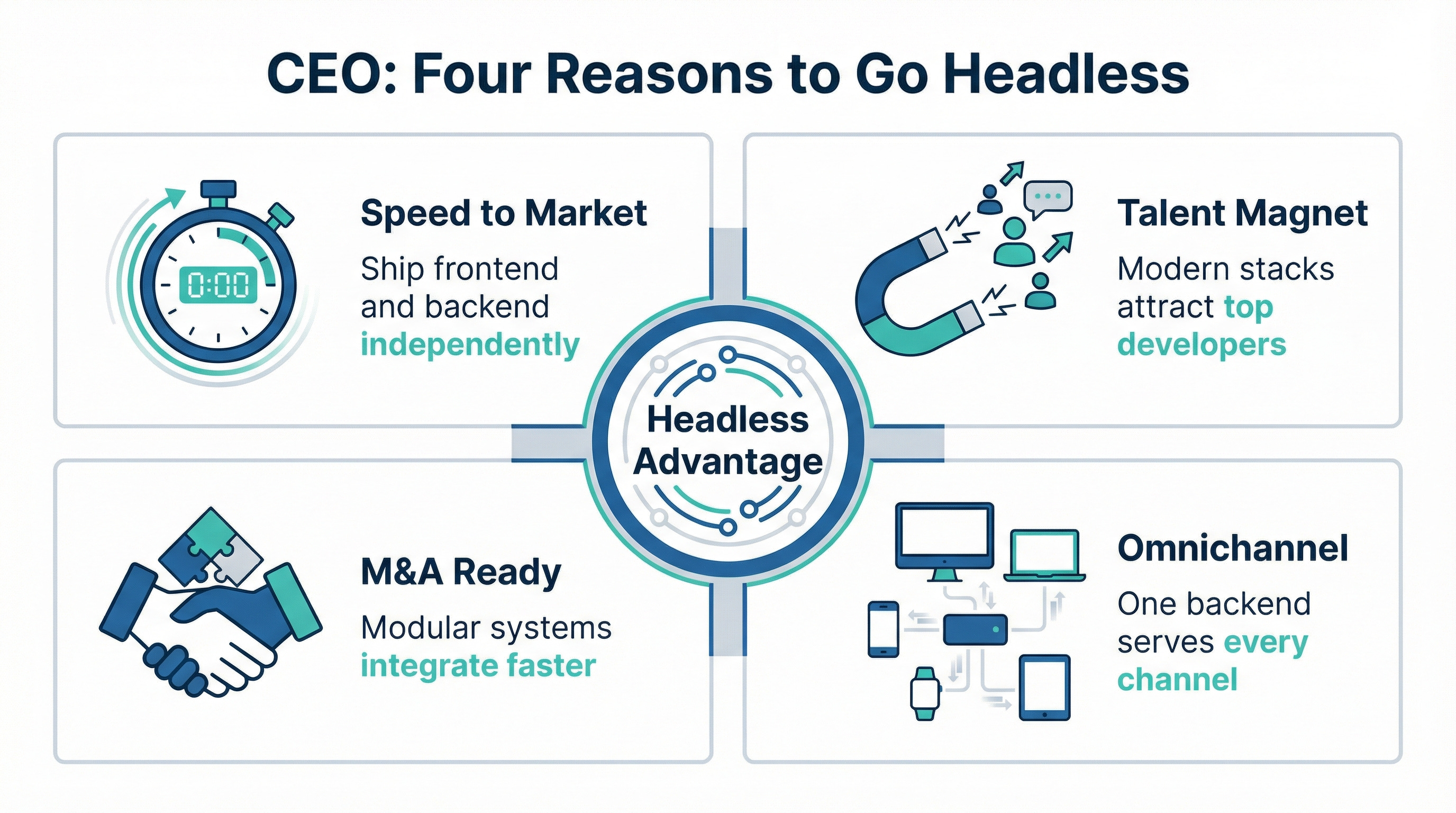
If you’re running the company, four things about this decision should keep you twiddling your thumbs.
Speed to market. In a monolithic setup, your front-end team and your back-end team work in the same codebase. One team’s deployment blocks the other’s. In headless, they’re independent. Your design team ships a new homepage while your engineering team overhauls the payment flow. Neither waits. In a competitive market where weeks matter, that’s how you compress timelines without compressing quality.
Talent acquisition. This one rarely makes the architecture slide deck, but it should. Top software developers want to work with modern tools. A job posting that says “React, headless CMS, modern API stack” attracts a fundamentally different applicant pool than “maintain legacy WordPress monolith.” Developer turnover in tech runs 20-25% annually. Your architecture is a recruitment tool whether you intended it to be or not.
System integration. When your organisation needs to connect with external agencies, partners, or new services, modular systems integrate faster. Connecting a headless platform to an external system? Plug their API into your existing front-end. Connecting two monoliths? Budget six to eighteen months to untangle incompatible architectures. Interoperability assessments increasingly flag monolithic architectures as integration risk.
Omnichannel without the duct tape. One back-end serving web, mobile, kiosk, IoT, voice assistants, and AI agents. Not six separate systems with six separate data models drifting out of sync. Every channel gets the same data, the same business rules, the same source of truth.
(Honestly, I’ve seen organisations run four different content management systems across four channels. The data never matches. Ever.)
The real CEO question: “Can we afford the competitive disadvantage of staying monolithic?”
The finance perspective
CFOs, this section is yours.
Headless architecture costs 20-50% more upfront than a monolith upgrade. That’s real money. On a $400K platform project, you’re looking at $480K-$600K. The instinct to choose the cheaper option is rational.
Over a five-year window, it’s also wrong. Here’s how the maths works.
Vendor lock-in cycles cost more than migrations. Every three to five years, monolithic platform vendors raise prices, deprecate features, or force upgrades. Each cycle costs organisations $500K or more in re-platforming, retraining, and lost productivity. Headless breaks this cycle because you own the components. Swap out Contentful for Sanity without touching your front-end. Replace Stripe with Adyen without redesigning the checkout. The switching cost for any single component is a fraction of a full platform migration.

Developer retention has a price tag. Replacing a developer costs the equivalent of 100-150% of their annual salary when you factor in recruiting, onboarding, and the three-to-six-month ramp to full productivity. Developers on modern stacks stay longer. Developers stuck maintaining legacy monoliths leave. It’s that simple. The architecture decision is a retention decision with a direct line to your hiring budget.
Performance converts to revenue. Industry research, most famously from Amazon, shows that every 100 milliseconds of page load improvement can increase conversions by roughly 1%. Headless front-ends built on modern frameworks beat monolithic platforms on load time because they’re optimised for exactly one job: delivering a fast user experience. On $10M in annual e-commerce revenue, a 300ms improvement could mean $300K in additional conversions.
Annually.

The headless CMS market alone is projected to grow from roughly $1.6-2.2 billion in 2025 to $5.5-6.5 billion by 2030, a 22-25% compound annual growth rate. The headless commerce market follows the same curve. The MACH Alliance, an industry consortium advocating for Microservices, API-first, Cloud-native, and Headless architectures, now has over 100 member companies, including commercetools, Contentful, and Algolia. Money is moving in one direction here.
Nike, Target, and Burberry have already made the switch. They didn’t do it because it was fashionable; rather, because the numbers worked.
Why React won (and what it means for your hiring budget)
You don’t need to become a front-end developer. But you do need to understand the labour market your engineering team hires from, because one framework has won so decisively that choosing anything else is a recruiting handicap.
React, built by Meta and released in 2013, has approximately 55 million weekly downloads on npm, the primary package registry for JavaScript. Its nearest competitor, Vue, has approximately 5-6 million. That’s roughly a 10:1 ratio.

In job postings, the gap is even starker. React appears in approximately 5 times more listings than Vue across major job boards. The Stack Overflow Developer Survey 2024 shows React at approximately 40% usage among web developers, Vue at approximately 16%. The State of JavaScript 2024 survey ranks React as the highest-retention front-end framework, meaning developers who use it keep choosing it.
Here’s the restaurant version. You’re opening a restaurant and need to hire chefs. Cuisine A has 25 qualified chefs in your town. Cuisine B has 5. Both cuisines are great. But when your head chef quits in six months (and in tech, someone always quits in six months), which cuisine lets you replace them without closing the kitchen?

Choosing a niche framework to save on licensing is like choosing a cheaper restaurant location in a town with no chefs. The savings evaporate when you can’t staff it.
Vue isn’t a bad framework. It has a passionate community, clean documentation, and real technical merits. But its relative market share is smaller and its mindshare is declining. For a business making a ten-year architecture bet, market gravity matters. You’re choosing a hiring pool as much as you’re choosing a technology.
But the most telling signal comes from Shopify itself. When the company that built one of the world’s most successful monolithic e-commerce platforms decided to create a headless framework, they chose React. They chose React because it’s where the developers are. Shopify’s Hydrogen framework is a React-based headless commerce solution.
The monolith king went headless. And it went React. If that doesn’t settle the framework question for your CTO, nothing will.

The agentic era: why headless is the only architecture that speaks AI
AI agents, software that can autonomously browse, decide, and act on behalf of users, are moving from research demos into production. And they don’t interact with your digital products the way humans do.
They don’t click buttons. They don’t scroll pages. They don’t care about your marketing copy.
They call APIs.
An AI agent checking whether you have a product in stock doesn’t visit your website and look for the “Check Availability” button. It sends a request to your inventory API and reads the structured response. An AI agent placing an order doesn’t fill out a checkout form. It calls your order API with a JSON payload containing the product ID, quantity, and payment token.

Monolith (no API):
AI Agent
   │
   ├─ Scrape HTML?
   ├─ Parse DOM?
   └─ Fragile. Breaks often.
Headless (clean API):
AI Agent
   │
   ├── GET /inventory ──► Stock data
   ├── POST /orders   ──► Place order
   └── GET /search    ──► Results
Monolithic platforms were built for human browsers. Their interfaces are HTML pages designed for eyeballs and mouse clicks. They might have basic APIs, but those APIs are afterthoughts: limited in scope, inconsistent in design, poorly documented. An AI agent trying to work with a monolith is like a delivery driver pulling up to a building with no loading dock. Technically possible. But slow, fragile, and full of workarounds.
Building a monolith in 2026 is like building a house without electrical wiring. It works today. It won’t work for anything you’ll need tomorrow.
Headless architecture is API-first by design. Every capability, from product search to order management to content delivery, is exposed through clean, documented, versioned endpoints. AI agents can check inventory, place orders, personalise experiences, update content, and trigger workflows through the same APIs your front-end already uses. Same door, different visitors.
Monolith API Surface:
┌─────────────────────────┐
│  ░░░░ Limited APIs ░░░░ │
│  Products (basic)       │
│  ...that’s about it     │
└─────────────────────────┘

Headless API Surface:
┌─────────────────────────┐
│  Products    ✓  Search ✓│
│  Orders      ✓  Auth   ✓│
│  Inventory   ✓  CMS    ✓│
│  Pricing     ✓  Users  ✓│
│  Workflows   ✓  AI     ✓│
└─────────────────────────┘
This is already happening. Gartner has endorsed composable commerce as the architecture best positioned for AI integration. Companies running headless are deploying AI agents that handle customer service, dynamic pricing, inventory management, and content personalisation through their existing APIs. Companies running monoliths? They’re still trying to figure out how to give their AI tools access to basic product data.
That gap widens every quarter.
The path forward: maintainability and developer happiness
One more argument for headless rarely makes the boardroom, but it drives the daily reality of your engineering team: the code itself is easier to live with.
Monolithic codebases grow into what developers call “big balls of mud.” (Yes, that’s the actual term.) Everything depends on everything. Changing one feature requires understanding fifty others. New developers take months to become productive because they need a mental map of the entire system before they can safely touch any part of it.
Headless codebases are smaller and focused. The front-end repository handles presentation. The CMS handles content. The commerce engine handles transactions. Each service has a clear boundary, a limited scope, and its own deployment pipeline. A new developer can become productive in the front-end codebase within weeks, because they don’t need to understand the payment processing system just to change a page layout.
Monolith:
┌───────────────────────┐
│ ONE GIANT REPO        │
│                       │
│  Everything tangled.  │
│  Change one thing,    │
│  break three others.  │
│                       │
│  Deploy all or none.  │
└───────────────────────┘
Headless:
┌─────────┐  ┌─────────┐
│Front-End│  │   CMS   │
│  Repo   │  │ Service │
└─────────┘  └─────────┘
┌─────────┐  ┌─────────┐
│Commerce │  │  Auth   │
│ Service │  │ Service │
└─────────┘  └─────────┘
Each deploys independently.
Independent deployability means your front-end team can fix a bug and ship it in minutes without waiting for a back-end release cycle. In a monolith, a front-end bug fix sits in a deployment queue behind back-end changes, database migrations, and infrastructure updates. In headless, it’s its own pipeline. Ship it. Move on.
Incremental upgrades become possible instead of terrifying. Want to upgrade your front-end framework from React 18 to React 19? Go ahead. The CMS doesn’t care. The commerce engine doesn’t even know. Each component evolves at its own pace without forcing synchronised upgrades across the entire stack.

Developer satisfaction is a leading indicator of velocity, quality, and retention. Every major developer survey, from Stack Overflow to State of JS to JetBrains, shows the same thing: developers working with modern, modular architectures report higher satisfaction, ship more often, and stay in their roles longer.
Happy developers ship faster, stay longer, and break less. The architecture choice is really a people choice wearing a technology hat.
When your annual developer turnover costs run into hundreds of thousands, the architecture that keeps your team engaged becomes a line item with a return.
What to do next
Shopify built one of the most successful monolithic e-commerce platforms in history. Millions of merchants. Billions in GMV. A stock price that made early investors very comfortable.
And then Shopify built Hydrogen: a React-based, headless commerce framework that lets merchants decouple their front-end from Shopify’s back-end.
When the monolith king invests in headless, that’s the market speaking. Not a blog post, not a conference talk; a strategic bet with engineering resources, product roadmap priority, and the company’s developer relations credibility behind it.
You don’t need to rip out your existing systems tomorrow. You don’t need to understand what an API endpoint is. You do need to do three things.
Ask your CTO one question: “If we needed to add a completely new sales channel in thirty days, could we?” If the answer involves caveats, clenched teeth, or the phrase “it depends,” your architecture is the bottleneck.
Ask your CFO one question: “What has our platform vendor cost us over the last five years, including the cost of things we couldn’t do because the platform didn’t support them?” That number is larger than the one on the invoice. It always is.
Stop delegating this decision entirely to IT. Architecture is a business decision with a technology implementation, not the other way around. You wouldn’t let IT choose your office lease without input. Don’t let them choose the system your entire digital strategy runs on without understanding what you’re buying.
Your CTO can tell you how to build it. But only you can decide what to build for.
The briefing is over. You’re ready for the next board meeting.

I write about technology strategy for business leaders regularly. If this kind of breakdown helps you make better decisions, subscribe so you don’t miss the next one.